Solution to the EU GNU Radio Days challenge

For the European GNU Radio Days 2021, Jean-Michel Friedt, as part of the organizing team set up a signal decoding challenge based on GPS signals. The price to the two best solutions was two USRP B205mini‘s kindly provided by NI Ettus, who sponsored the conference.

I managed to solve this challenge shortly after it was published, and sent Jean-Michel a Jupyter notebook explaining my solution. Jean-Michel liked this approach and invited me to present my solution today at the conference. This presentation can be watched in the recording of the conference livestream.

I have now published a repository with all the material of my solution. Thanks to Jean-Michel for putting together this interesting and enjoyable challenge and to NI for providing a prize to make the challenge more attractive.
Rain backscatter on 10 GHz

Yesterday we had a strong storm in Madrid at around 16:30 UTC. The storm was rather short but intense. Seeing the heavy rain, it occurred to me that I might be able to receive the 10 GHz beacon ED4YAE at Alto del León using my QO-100 groundstation (without moving the antenna).

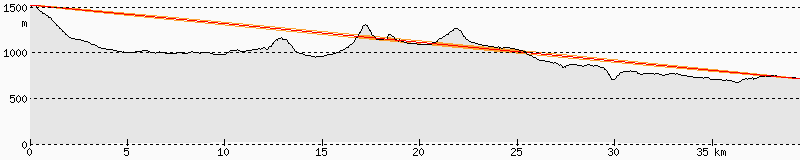
The 10 GHz beacon is 39.4 km away and the direct path to my station is obstructed by some hill in the middle, as shown in the link profile.

Link profile ED4YAE -> EA4GPZ (from HeyWhatsThat.com)

In the countryside just outside town it is possible to receive the beacon, probably because it diffracts on the hills. However, it is impossible for me to receive it directly from home, as there are too many tall buildings in the way.

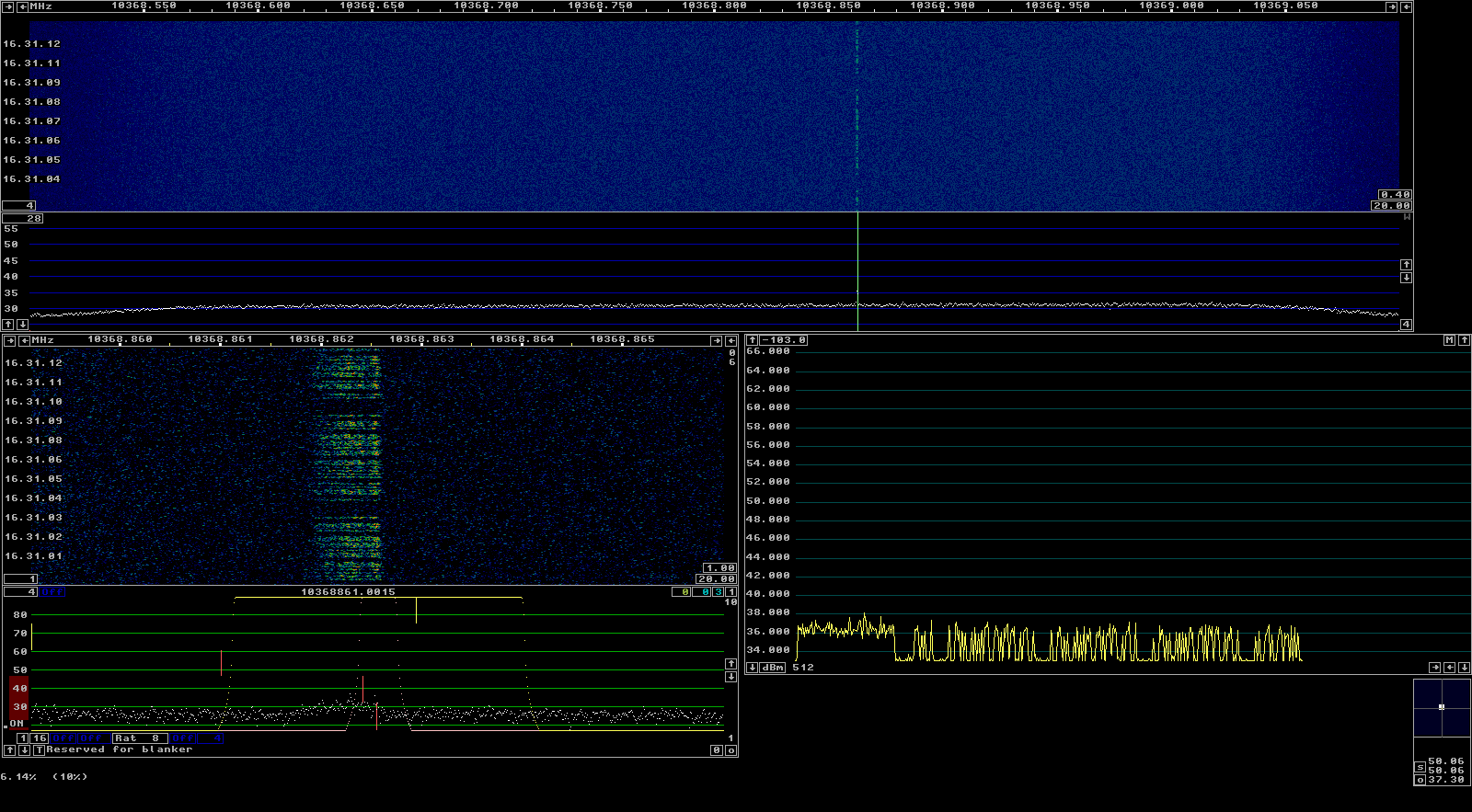
In fact, when I fired up my receiver as the storm raged, I was able to see the beacon signal, with a huge Doppler spread of some 700 Hz (20 m/s). The CW ID of the beacon was easy to copy.

ED4YAE -> EA4GPZ at 10 GHz via rain backscatter

Then I started recording the signal. As the rain got weaker, it started disappearing, until it faded away completely. This post is a short analysis of the scatter geometry and the recording.

GPS spectrometry at Allen Telescope Array

Over the last few weeks I have been helping the Allen Telescope Array by calibrating the pointing of some of the recently upgraded antennas using the GNU Radio backend, which consists of two USRP N32x devices that are connected to the IF output of the RFCB downconverter. For this calibration, GPS satellites are used, since they are very bright, cover most of the sky, and have precise ephemerides.

The calibration procedure is described in this memo. Essentially, it involves pointing at a few points that describe a cross in elevation and cross-elevation coordinates and which is centred at the position of the GPS satellite. Power measurements are taken at each of these points and a Gaussian is fitted to compute the pointing error.

The script I am using is based on this script for the CASPER SNAP boards, with a few modifications to use my GNU Radio polarimetric correlator, which uses the USRPs and a software FX correlator that computes the crosscorrelations and autocorrelations of the two polarizations of two antennas. For the pointing calibration, only the autocorrelations are used to measure Stokes I, but all the correlations are saved to disk, which allows later analysis.

In this post I analyse the single-dish polarimetric spectra of the GPS satellites we have observed during some of these calibrations.