Receiving the Psyche launch

On Friday, the Psyche mission launched on a Falcon Heavy from Cape Canaveral. This mission will study the metal-rich asteroid of the same name, 16 Psyche. For more details about this mission you can refer to the talk that Lindy Elkins-Tanton, the mission principal investigator, gave a month ago at GRCon23.

The launch trajectory was such that the spacecraft could be observed from the Allen Telescope Array shortly after launch. The launch was at 14:19 UTC. Spacecraft separation was at 15:21 UTC. The spacecraft then rose above the ATA 16.8 degree elevation mask in the western sky at 15:53 UTC. However, the signal was so strong that it could be received even when the spacecraft was a couple degrees below the elevation mask, so I confirmed the presence of the signal and started recording a couple minutes earlier. At this moment, the spacecraft was at a distance of 18450 km. The spacecraft continued to rise in the sky, achieving a maximum elevation of 32.9 degrees at 16:53 UTC, and setting below the elevation mask on the west at 19:22 UTC. At this moment the spacecraft was 103800 km away. The signal could still be received for a few minutes afterwards, but eventually became very weak and I stopped recording.

Since the recording started only 30 minutes after spacecraft separation, we get to see some of the events that happen very early on in the mission. Most of the observations of deep space launches that I have done with the ATA have started several hours after launch. This Twitter thread by Lindy Elkins-Tanton gives some insight about the first steps following spacecraft separation, and I will be referring to it to explain what we see in the recording.

I intend to publish the recordings in Zenodo as usual, but the platform has been upgraded recently and is showing the following message “Oct 14 12:03 UTC: We are working to resolve issues reported by users.” So far I have been unable to upload large files, but I will keep retrying and update this post when I manage.

Update 2023-10-19: Zenodo have now solved their problems and I have been able to upload the recordings. They are published in the following datasets:
BSRC REU GNU Radio tutorial recordings

Since 2021 I have been collaborating with the Berkeley SETI Research Center Breakthrough Listen Summer Undergraduate Research Experience program by giving some GNU Radio tutorials. This year, the tutorials have been recorded and they are now available in the BSRC Tech YouTube channel (actually they have been there since the end of August, but I only realized just now).

These tutorials are intended as an introduction to GNU Radio and SDR in general, focusing on topics and techniques that are related or applicable to SETI and radio astronomy. They don’t assume much previous background, so they can also be useful for GNU Radio beginners outside of SETI. Although each tutorial builds up on concepts introduced in previous tutorials, their topics are reasonably independent, so if you have some background in SDR you can watch them in any order.

All the GNU Radio flowgraphs and other materials that I used are available in the daniestevez/reu-2023 Github repository. Below is a short summary of each of the tutorials.

Observing OSIRIS-REx during the capsule reentry

On September 24, the OSIRIX-REx sample return capsule landed in the Utah Test and Training Range at 14:52 UTC. The capsule had been released on a reentry trajectory by the spacecraft a few hours earlier, at 10:42 UTC. The spacecraft then performed an evasion manoeuvre at 11:02 and passed by Earth on a hyperbolic orbit with a perigee altitude of 773 km. The spacecraft has now continued to a second mission to study asteroid Apophis, and has been renamed as OSIRIS-APEX.

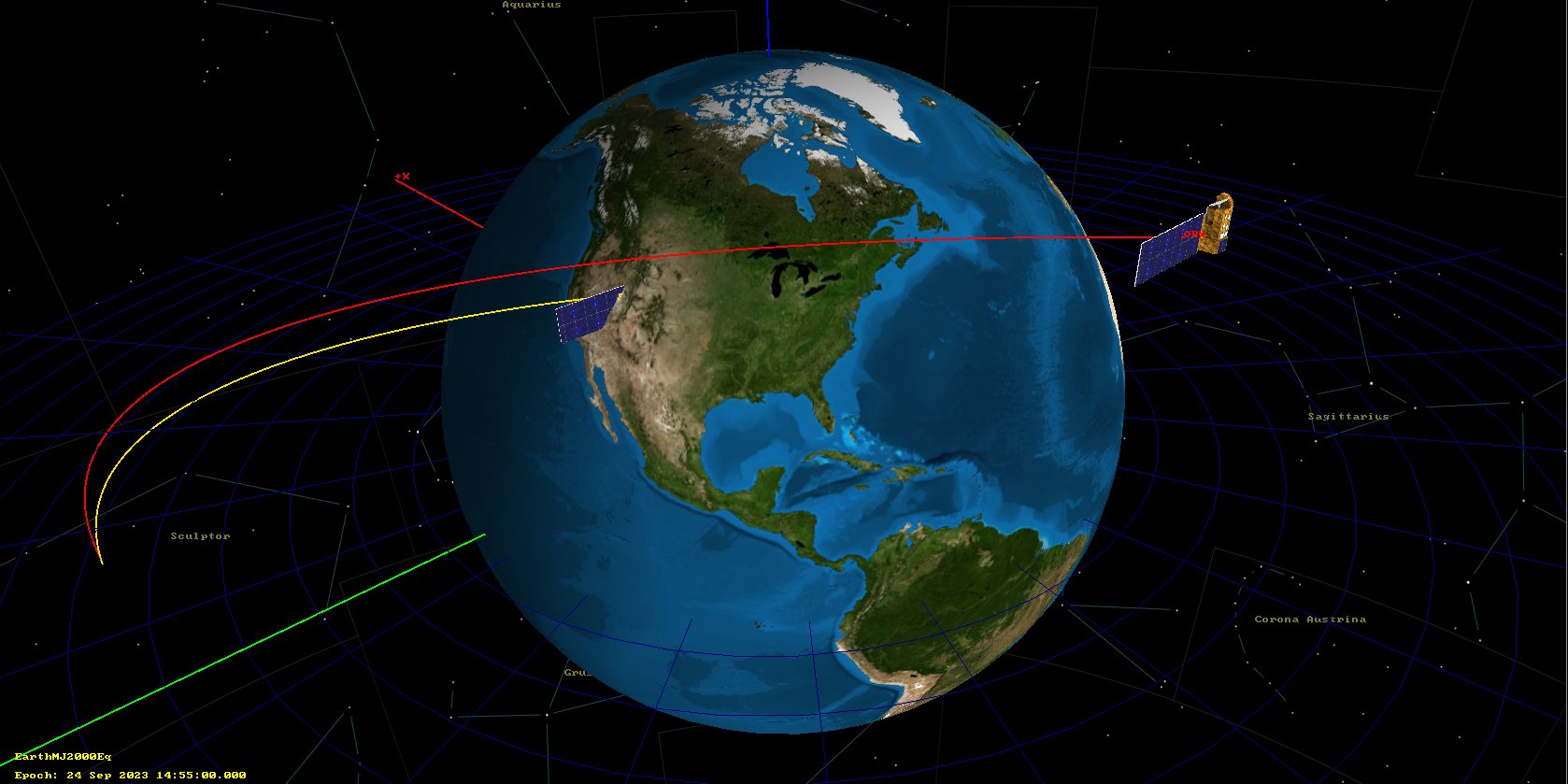
This simulation I did in GMAT shows the trajectories of the spacecraft (red) and sample return capsule (yellow).

Trajectory of OSIRIX-REx and sample return capsule

Since the Allen Telescope Array (ATA) is in northern California, its location provided a great opportunity to observe this event. Looking at the trajectories in NASA HORIZONS, I saw that the sample return capsule would pass south of the ATA. It would be above the horizon between 14:34 and 14:43 UTC, but it would be very low in the sky, only reaching a peak elevation of 17 degrees. Apparently the capsule had some kind of UHF locator beacon, but I had no information of whether this would be on during the descent (during the sample return livestream I then learned that the main method of tracking the capsule descent was optically, from airplanes and helicopters). Furthermore, the ATA antennas can only point as low as 16.8 degrees, so it wasn’t really possible to track the capsule. Therefore, I decided to observe the spacecraft X-band beacon instead. The spacecraft would also pass south of the ATA, but would be much higher in the sky, reaching an elevation above 80 degrees. The closest approach would be only 1000 km, which is pretty close for a deep space satellite flyby.

As I will explain below in more detail, I prepared a custom tracking file for the ATA using the SPICE kernels from NAIF and recorded the full X-band deep space band at 61.44 Msps using two antennas. The signal from OSIRIS-REx was extremely strong, so this recording can serve for detailed modulation analysis. To reduce the file size to something manageable, I have decimated the recording to 2.048 Msps centred around 8445.8 MHz, where the X-band downlink of OSIRIS-REx is located, and published these files in the Zenodo dataset “Recording of OSIRIS-REx with the Allen Telescope Array during SRC reentry“.

In the rest of this post, I describe the observation setup, analyse the recording and spacecraft telemetry, and describe some possible further work.

Update on the Galileo GST-UTC anomaly

At the beginning of September I wrote about an ongoing anomaly in the offset between the GST (the Galileo System Time) and the UTC timescales. This short post is an update on this problem, with new data and plots.

For this post I have only used final solutions for the CODE precise clock biases. I have replaced the rapid solutions that I used in the last post by their final versions. The data under analysis now spans from day of year 225 (2023-08-13) to day of year 266 (2023-09-23).

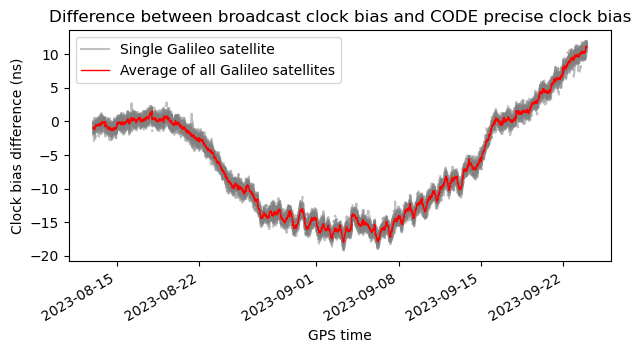
The plot of the difference between the broadcast clock biases and the CODE precise clock biases now has the following aspect. Comparing with the previous post, we see that the difference has stayed around -15 ns until 2023-09-08, and then it has started increasing towards zero, but it has overshoot and it is at around 20 ns by 2023-09-23.

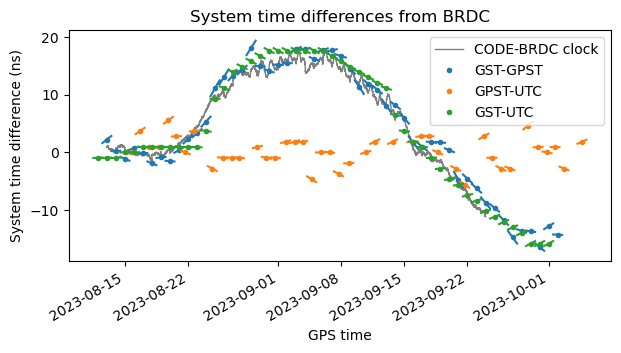
The plot of the system time differences in the broadcast messages is also quite interesting. For this I am using the IGS BRDC data until day of year 275 (2023-10-03). Recall that it appeared that the GST-UTC drift had the wrong sing, because it was clearly increasing but the drift had negative sign. Now the situation looks more complicated. Though it appears that the drift has the wrong sign around 2023-08-28 and 2023-09-22, there is also a segment around 2023-09-08 where the sign looks correct. Additionally, around 2023-09-01 the sign should be close to zero but is not.

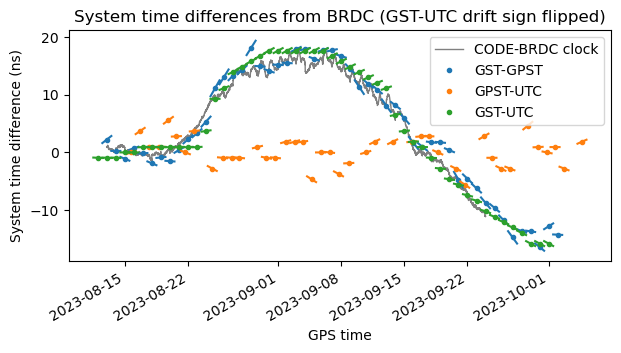
For comparison, here is the same plot with the sign of the GST-UTC drift flipped. Arguably, the drift gives a better match most of the time, but certainly not around 2023-09-08. Therefore, the problem with the modelling of the GST-UTC drift in the Galileo broadcast message looks more complicated than just the sign bit being wrong.

The updated Jupyter notebook and data is in this repository.

Published
Categorised as Space Tagged