Thomas Telkamp has shared with me an IQ recording of the Tianwen-2 telemetry downlink made with the Bochum 20 metre antenna on June 8. This is part of an ongoing effort led by Peter Gülzow, AMSAT-DL‘s president, for closely monitoring Tianwen-2’s operations. All the material I have used in previous posts about Tianwen-2 has come from these activities.
This recording was made just before Tianwen-2 did a manoeuvre (recall that the orbital insertion at asteroid Kamo’oalewa was reported to be on June 7). During this recording Tianwen-2 was transmitting telemetry at a slower rate than the usual 16384 baud. This makes sense, given the fact that the attitude during the manoeuvre would be unfavourable. In this short post I decode this recording.
The only two configuration differences between the regular 16 kbaud telemetry and this lower data rate telemetry is that the baudrate is reduced to 4096 baud, and the frame size is reduced to 220 bytes. This means that a single Reed-Solomon codeword from the shortened (252, 220) code is used, instead of four interleaved Reed-Solomon codewords from the full (255, 223) code. The over-the-air frame duration is still one second.
The corresponding modifications to the GNU Radio decoder are simple. This plot shows the decoder running on the recording. The SNR is excellent.
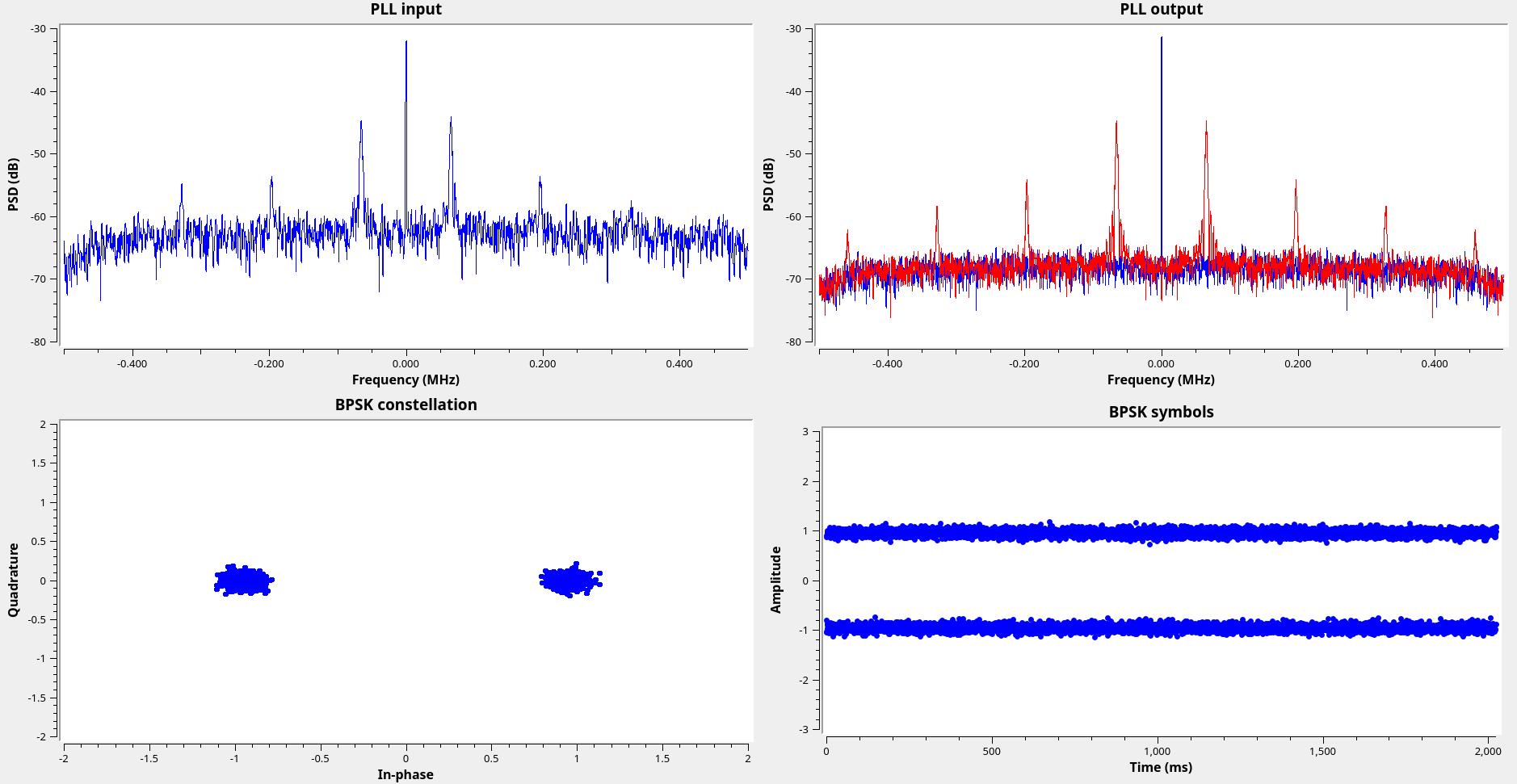
The contents of the telemetry frames are the same as the regular 16384 baud telemetry. There are very few differences. One difference is that the last two bytes of the AOS insert zone, which are always 0x300b in 16384 baud telemetry, are always 0x0001 in this 4096 baud telemetry. I don’t know what these bytes mean, and this difference doesn’t give me a clue either.
Almost all the same APIDs as in the regular telemetry are present, although their transmission rate is reduced due to the lower data rate. Comparing, I see that only APIDs 1553 and 1554 are missing in the low rate telemetry.
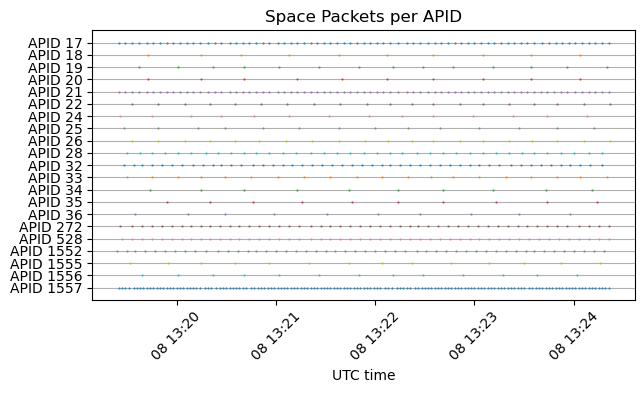
The GNU Radio decoder used in this post is here, the Jupyter notebook is here, and the binary file containing the decoded frames is here.
One comment